Teaching Subject And Topic Information (Autism Help)

  • Category: Teaching Tutorials
  • Status: Complete

The video above is a tutorial that discusses the importance of Teaching Subject and Topic information to children who are at the level of non-verbal and autistic, it also demonstrates how to present this information to them, if you need to know more about why it is so important to give this information to children with autistic difficulties then please read the following article:

The Importance Of Presenting Subject And Topic Information To Children With Autism

Below are a number of detailed steps broken down to demonstrate some of the methods that can be used to teach Subject and Topic Information as discussed in the video:

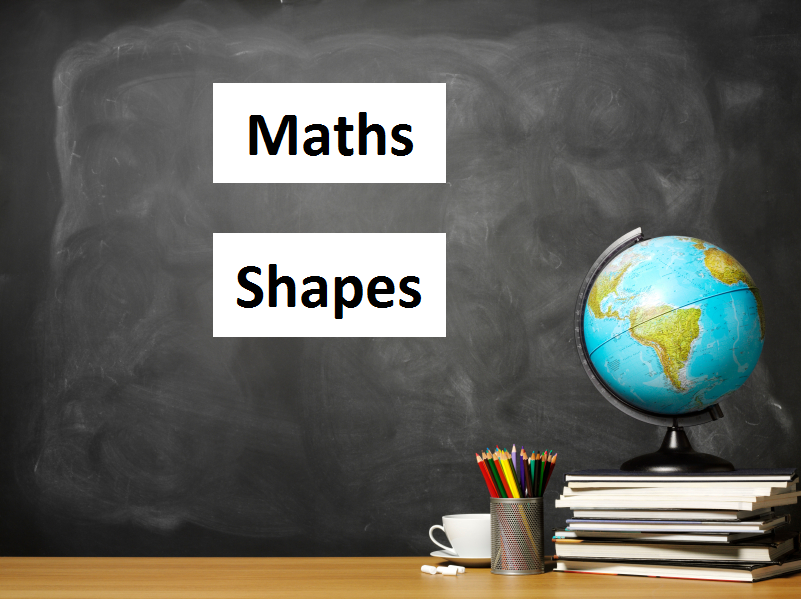
  • Depending on the students level of understanding start out with just two words (Subject and Topic for example: Maths and Shapes). If the student is not yet ready for two words then start out with one word (Subject example: Maths). Never use more than two words until there is undisputable proof that the student is ready to process more additional information without it causing visual overload.
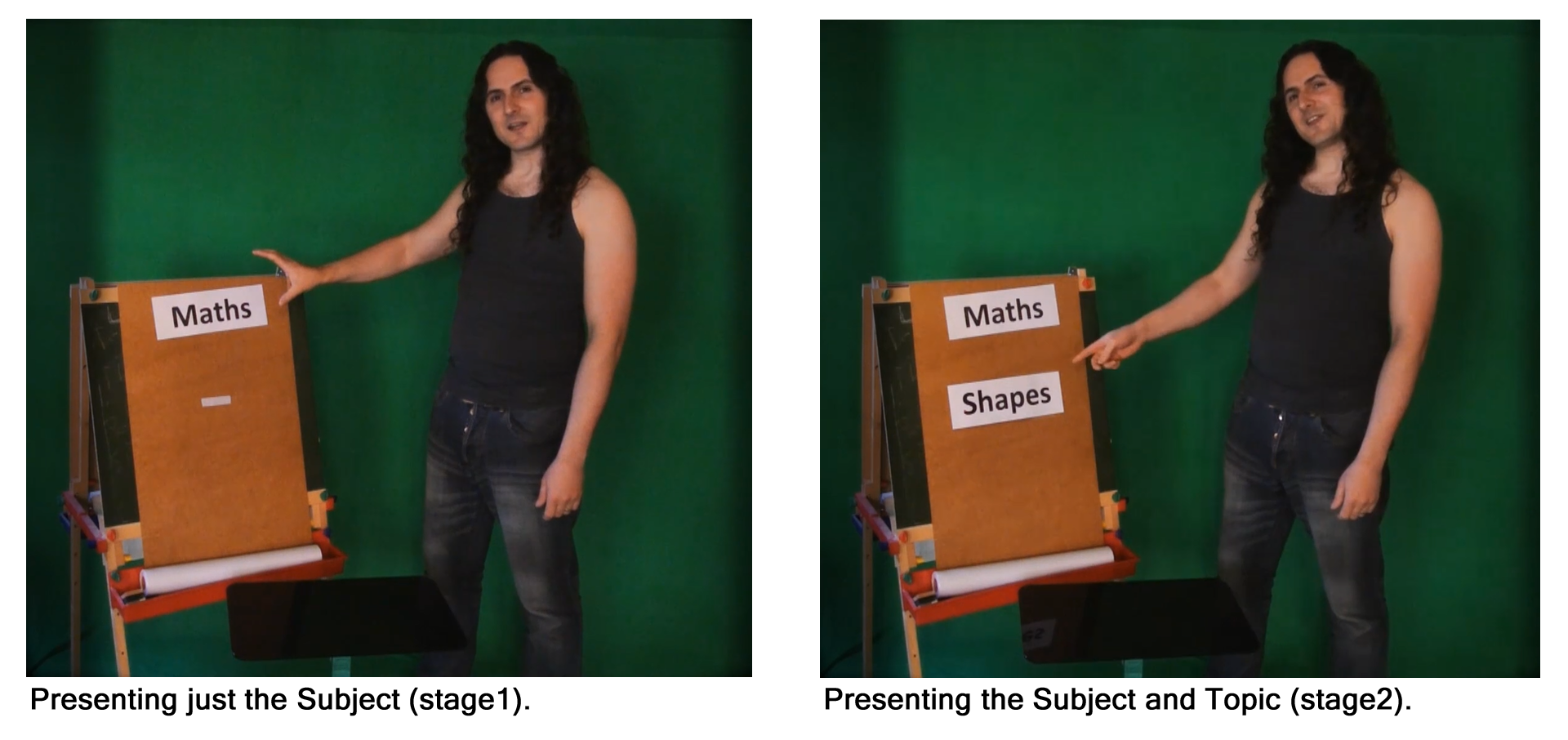
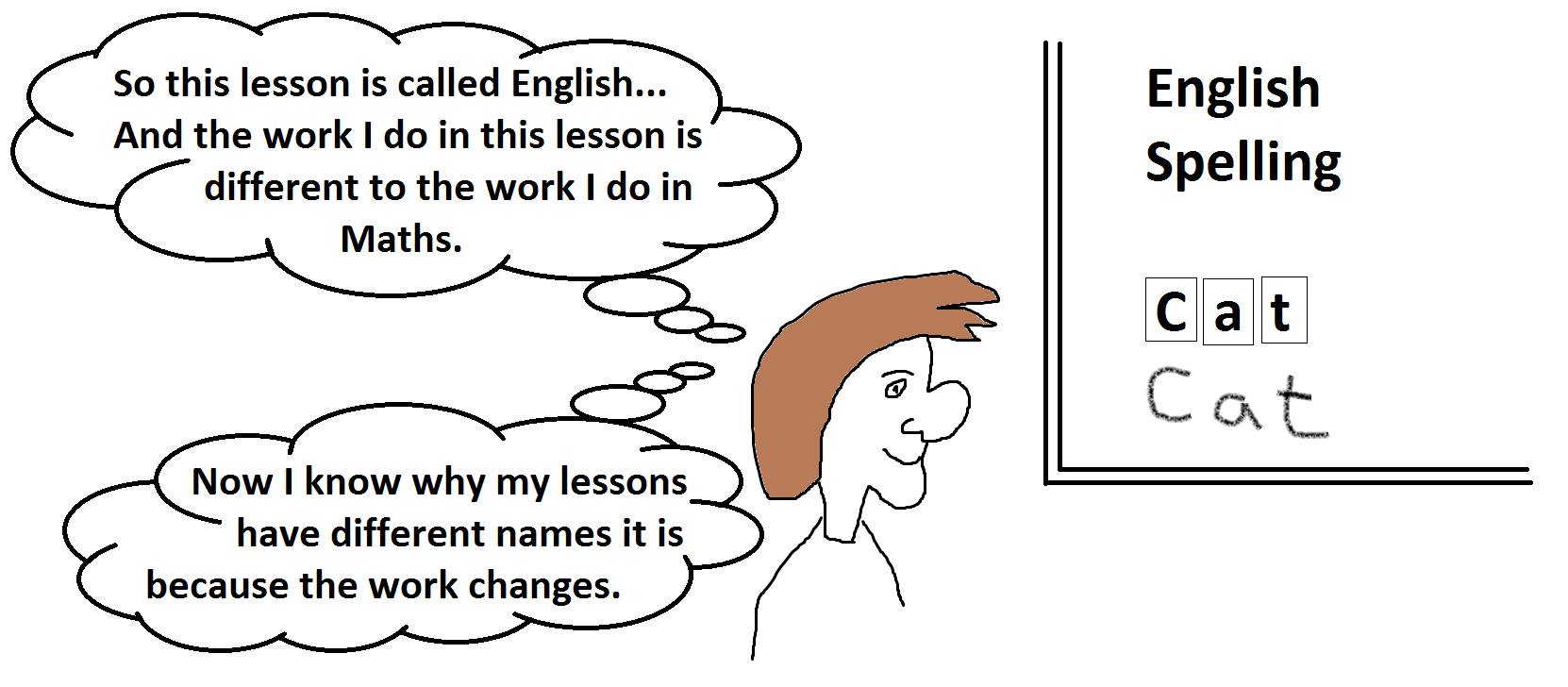
example1

  • Make sure that the word or words you plan to present to the student are clear and well defined (never use an over fancy or busy style fonts – always keep this information clear and simple). Above all be sure to go large print or writing (because if the information is small they are more likely not to notice or understand and additionally this may make the student upset by its lack of presence especially if we are to persist in trying to direct their attention towards inadequately presented information).

example3

  • Always present this information at the start of the lesson so that it is the first thing they are thinking about before the lesson work begins. If you are using two words:
  1. Make sure they are printed or written on separate sheets.
  2. Never show them both words at the same time as; they need to learn these words separately and in sequential order so they are able to develop an understanding in relation to the individual and separate meanings for each Subject and Topic whereas showing both the Subject and Topic at the sametime would very easily be viewed as a combined meaning or simply misunderstood altogether.
  • Always make sure the information is on display throughout the entire lesson and be sure to always place the Topic underneath the Subject as to emphasize that the Topic falls underneath the Subject to help build that categoric understanding (remember that the Subjects will be studied repeatedly but the Topics within the Subjects will change considerably).
  • When displaying this information throughout the lesson always ensure it is in the students direct view and that it is displayed in a large clear open area where it will be obviously visible (never place this information in a cluttered area or a place on the wall or board amongst lots of other information where it will not standout or become lost in translation by visual overload from other surrounding information).
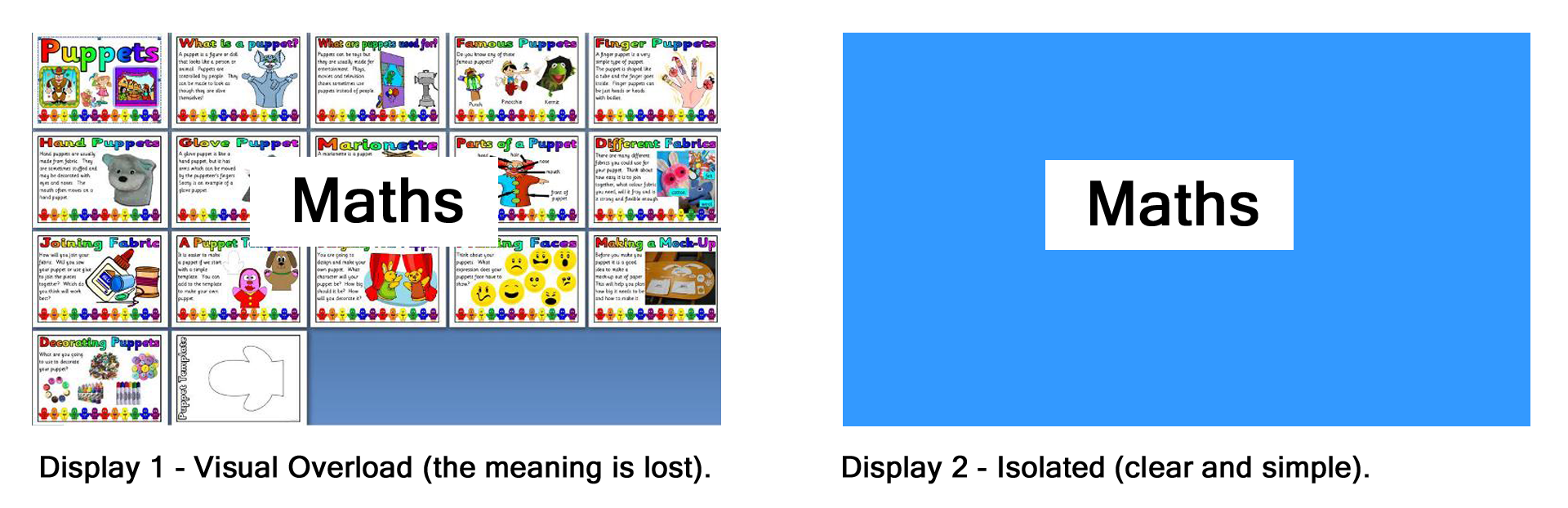
example2

Presenting This Information With Interaction

In order to engage the students attention and make them both aware of this information and the value of its importance follow the steps below:

  • Engage the student by showing them the first word (for example Maths).
  • When the student is looking and listening point to the word and say e.g. “Maths”.
  • Place the ‘Maths’ sign on the wall/board (or chosen display area).
  • Now do the same with the Topic by showing it to them.
  • When the student is looking and listening point to the Topic and say e.g “Shapes”.
  • Now place the Topic on the wall/board (or chosen display area) underneath the Subject.
  • Be sure that the student both looks and listens to this information by watching their facial expressions and eye contact – if the student was neither looking or listening take the following steps:
  1. Engage the student by taking this information directly to them.
  2. Place this information (the first sign e.g. ‘Maths’) on a clear flat surface like a desk or table in front of the student.
  3. Engage their visual understanding by saying “look” and pointing toward your eyes (almost like you are saluting).
  4. Point then to the sign/word and speak its name e.g. “Maths” and be sure they were looking at this information while you were speaking.
  5. If the student is still not paying attention or looking use the hand over hand method (holding their hand and helping them point using their index finger) so that they point to this information with their own finger and again make sure they are looking at this information while you speak the words e.g. “Math”.
  6. If they are still not paying attention say “look” and then using their own finger with the hand over hand method  keep tapping the word/sign with their finger until they take the time to look at it and then while they are looking at it speak the word name “Maths”.
  7. Now we can place this word in clear view so that they can see it throughout the lesson.
  8. If you are using two words (a Subject and a Topic) repeat the above steps but this time using the second word and when the process is complete place the second word underneath the first word so that both words are in clear view for the student to see throughout the entire lesson.

Reinforcing The Importance Of This Information With Responsibility

A Great way to add meaning and value to the students understanding with an additional benefit of building on their self confidence is to take the further steps in making the student responsible for this information and keeping it up to date – here is a useful breakdown of the steps that will help make this happen:

  • First use the above process and steps to present the Subject and Topic information to the student and also to establish that the student is both looking and listening (seeing and hearing) the information we are presenting – maintain that process to the point that they are beginning to anticipate the expectation that this process will happen in every class of every day, when we reach this stage the student will now be both ready and more amenable to accepting the responsibility we are about to teach them.
  • Make sure that the information we have been showing the student has a good place to be both stored and displayed in the classroom that will be easy for the student to access so that they will be able to; add, remove and replace the word information each time it is necessary in the lesson for the Subjects and Topics to be updated.
  • Use velcro attachments on the wall/board (or display area) and also on the back of each sign (or any other practical method you may think of for attaching this information securely while it is being display) as a way to make it easy in keeping this information in the right place every time it is updated.
  • Talk the student through updating this information using the following steps:
  1.  Engage the students visual concentration by saying “Look” (be sure to point toward your eyes like you are saluting).
  2. Then point to the ‘Subject’ and speak its name “Maths” (ensure the student is looking as you do this; if they are not then follow the hand over hand method in the details above).
  3. When you are sure you had the students attention and they both looked and listened as you spoke to them, tell them the first part of their task by saying to the student “Pick it up” (or if they need a single word to develop this understand use “take” or “carry”) and again point to the word/sign.
  4. If the student does not follow your instructions then using hand over hand get them to pick up the word/sign.
  5. Go to the display area with the student, point at the display and say “Put it here” or “Here” (whichever is more relevant to their level of understanding).
  6. If the student does not follow your instructions or drops the sign, pick it up and put it back in their hands and then take them with the sign to the wall (or display area).
  7. Get the student to attach the sign to the wall (or display area) if they need help to do this then again show them how and also try to use hand over hand in getting them to do this process so that they feel their involvement.
  8. Ideally you want them to do this process unassisted with just spoken instructions until it becomes established, if they are unable to complete this process without help then support them but always be mindful about reducing the level of support being given so that the long term learning/goal of this process becomes them completing this task in its entirety without assisted participation (as the end result is a responsibility for them that will also aid their learning).

The more responsible the student becomes in maintaining this information will greatly increase the students understanding of curriculum improving their expectational understanding for each lesson they study and raising their level of participation within each lessons while building a wider and more categorized understanding of learning that helps breaks down the complexity of information of which they are being taught.

© AORPETE LEARNING
The Importance Of Presenting ‘Subject’ And ‘Topic’ Information To Children With Autism

  • Category: Information
  • Status: Complete

2 Maths Shapes

Subjects And Topics

When teaching a student who is at the level of non-verbal and autistic it is so important to give them this information firstly at the start of every lesson (before the lesson itself commences) and secondly at a level they will understand so that over a period of time they can really develop an understanding through the frequency of a regularly structured routine that role models this type of information.

Q. So why then specifically are Subjects and Topics so important to teach to students who are at the level of non-verbal and autistic?

A. Subjects and Topics are so important to teach because:

  • They are informative.
  • They create an understanding.
  • They build bridges that connect information.
  • They catalog information by separating it into groups that make it more manageable and easier to understand. 
  • They enhance short term learning while developing long term understanding.

Subjects And Topics Are Informative

Imagine being taught at school without ever having the understanding to know that; even though each lesson is different all the information you are learning is being filed into one single category of information without ever being broken down into smaller digestible amounts or being filed into the relevant categories because you have never been presented with the relevant information that would enable you to develop this level of understanding and so therefore what you are learning is just being filed as one great mighty category or mass of information that never ends with no named boundary markers to distinguish the categorical differences or a way to draw a line between the various areas of information being studied.

8-redundant-info

Subjects And Topics Create An Understanding

When this information is labeled appropriately as Subjects and Topics  it becomes digestible forming a creative understanding like a virtual folder of information within each students thought process which then links; the work they complete in their lessons to those important names associated with the work (Subjects and Topics). This then enables the student to find some closure in knowing that; when a lesson ends a line of divide can now separate each area of study through the students progressive understanding of Subject and Topic information allowing them to develop the process of mentally labeling and filing the information they have learned within separate categories; which otherwise is like a ticking time bomb of emotional discord waiting to explode by creating an overwhelming feeling that; the information being taught is just one mighty mass of data that just keeps piling-up getting bigger and bigger which will have the knock-on effect of:

  1. Limiting the students ability to process information.
  2. Limiting the students ability to understand information.
  3. Holding the student back from ever achieving their true potentials.

work_piling_up_1_137190044_std

Subjects And Topics Build Bridges That Connect Information

Even if the student starts out with no knowledge or understanding at all in relation to the meaning of each Subject and Topic being studied, by giving them this information (Subject and Topic) everyday as part of a routine at the start of each lesson throughout the day will help them building those important connections in knowing that; each time they see and hear the Subject and Topic information their studies will commence in a certain way which in turn builds familiarity through this process of routine by; the words they are seeing and hearing in relation to the work in which they are participating and therefore making it possible for them to develop a healthy knowledgeable understanding in being able to mindfully identify; what work they will be expecting to study from the moment the Subject and Topic information is announced to them.

cartoon strip 1

Subjects And Topics Connect Information By Separating It Into Groups

In the short term, when both the Subject and Topic information change the student starts beginning to understand that the work they are completing is not just different but that it is also labeled differently and over a period of time using this method for role modeling will teach students how to cataloged information by using this type of thought processing which in turn will develop categorical understanding that makes it possible for all kinds of information to be both manageable as well as connected, digestible and understood.

cartoon strip 2

Subjects And Topics Enhance Short Term Learning While Developing Long Term Understanding

When each Subject and Topic loops back round and the student continues working while being made aware of this information connections then start to form and bridges are built which make it easier for the student to understand that; the work they are doing this time connects to the same work they were doing last time and now this information can be filed along with the last lot of information they learned in this area (rather than separately with a disassociated meaning or together with everything else in its entirety where the meaning becomes lost because there is both no relevant connections or meaning when information is given and processed as such a large disjointed quantity). By having a really clear and well defined standout process of presenting Subject and Topic information makes the continuation of work feel joined, whole, more rounded while making its application so much more useful and effective in helping the student to become more confident, practical and proactive within each area of study by their new found categorical understanding of information.

cartoon strip

Additionally the Long Term Learning in this area will develop when the student is taught specific information that they may or may not fully understand (at the point where the learning process begins) but with a consistency of routine practice over a long period of time will come an enhanced understanding with new abilities (that often go way beyond the anticipated scope of outcome) to support levels of intelligence that will evolve through the practice and participation of study which in short are the key elements or building blocks to unlocking this developmental process (and if the student in question is at the level of non-verbal and autistic it will often fall to those role modeling people who participate within the students life to deliver this type of structure appropriately by initially teaching this information at a basic level the student can begin to understand; as very often students themselves with such levels of difficulty will most likely not yet be able to understand and appreciate the importance or value in taking such steps or even how to begin taking them without the support of their role models who have the ability to help them achieve such inspiring goals).

Q. How then would you start teaching this information to a student at the level of non-verbal and autistic?

A. The following article has a video tutorial and discusses methods, techniques including; how and when to teach this information – give it a click to find out more:

Teaching Subject And Topic Information (Autism Help)

© AORPETE LEARNING

Manners And People

  • Category: Words Communication Tutorials
  • Status: Complete

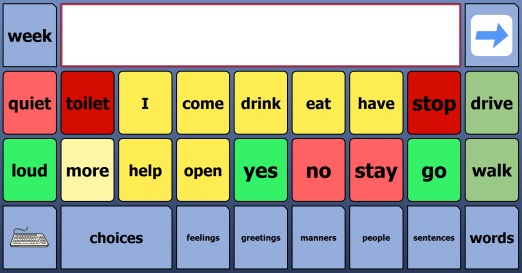
This video explores the ‘Manners’ and ‘People’ categories on the Words Communication Application I created for Lia and the relationship these categories have with one another in how they connect to the grammatical communication system to support role modeling aspects by linking manners to requests and directing both manners and requests to a person who can help with the requests that are being made by the student.

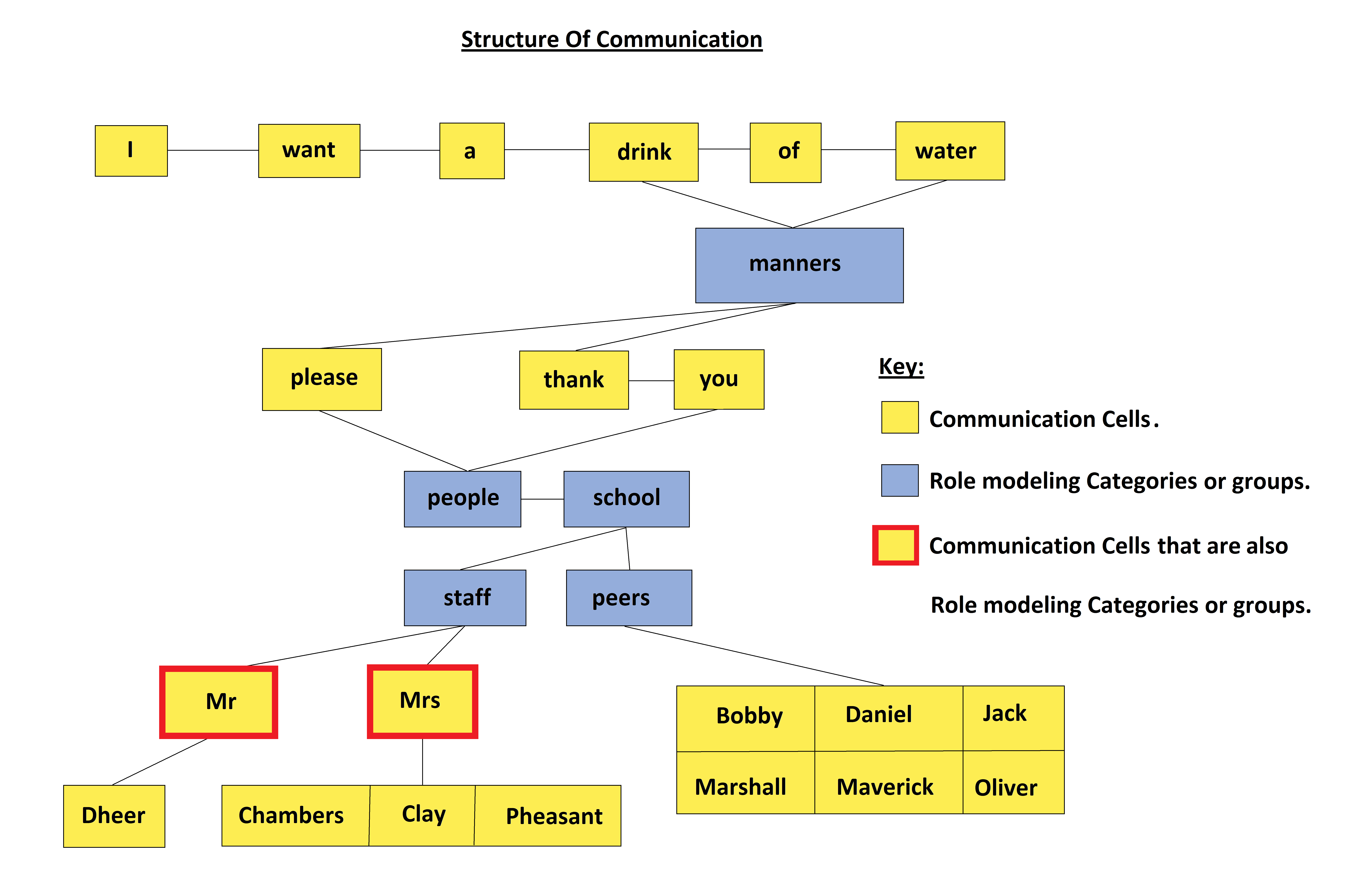
communication structure

The above diagram is an example of the communication structure that shows how a sentence is constructed (using the yellow speaking cells that are assembled in sequential order onto the workspace as they are selected) and how these categories and groups are role modeled (using the blue cells which speak as they are selected but do not go into the workspace) with the end result displaying the completed sentence in the workspace which can then be broadcasted in its entirety when the ‘Speak’ button is pressed.

speak

Role modeling works on two levels:

The First Level Of Role Modeling

The first level is the speaking categories or groups (blue categories/groups that provide important information that is spoken aloud so the student sees and learns this information without it filtering into the workspace). While these blue categories or groups are useful role modeling markers they are not information that would work in forming a completed sentence for example you would not say:

“I want a drink manners please”

You would instead say:

“I want a drink please”

Seeing and hearing the ‘manners’ group during the sentence construction is good for the purposes of role modeling, however when the sentence is completed and the ‘Speak’ button is pressed the sentence sounds both correct and meaningful by only displaying and speaking the relevant information about the request:

“I want a drink please”

This then teaches values during the sentence construction and correctness during the sentence vocalisation. Some of the speaking categories and groups are yellow cells (just like the regular speaking cells) yellow speaking category or group cells provide important information (just like the blue cells) but they also become a part of the completed sentence in the appropriate place during the sentence construction. The reason these categories or groups are yellow instead of blue and go into the workspace is because they are a relevant part of the completed sentence for example:

“Mr” or “Mrs”

Both of these choices are actually groups but they are also a relevant part of the sentence creation in that it is appropriate practice to use their group/categoric information before speaking a teachers surname for example:

“Mrs Pheasant”

Whereas it would be inappropriate and impolite to simply just say:

“Pheasant”

Additionally surnames used without the title first take on a whole new meaning such as the example above which demonstrates why some categories or groups are required to go into the workspace for the purpose of keeping the role modeling appropriate whereas others (the blue categories/groups) would not.

The Second Level Of Role Modeling

A second level of communication role modeling comes into play by offering relevant categories or groups of information in the appropriate place for the creation of a grammatical sentence such as the example below:

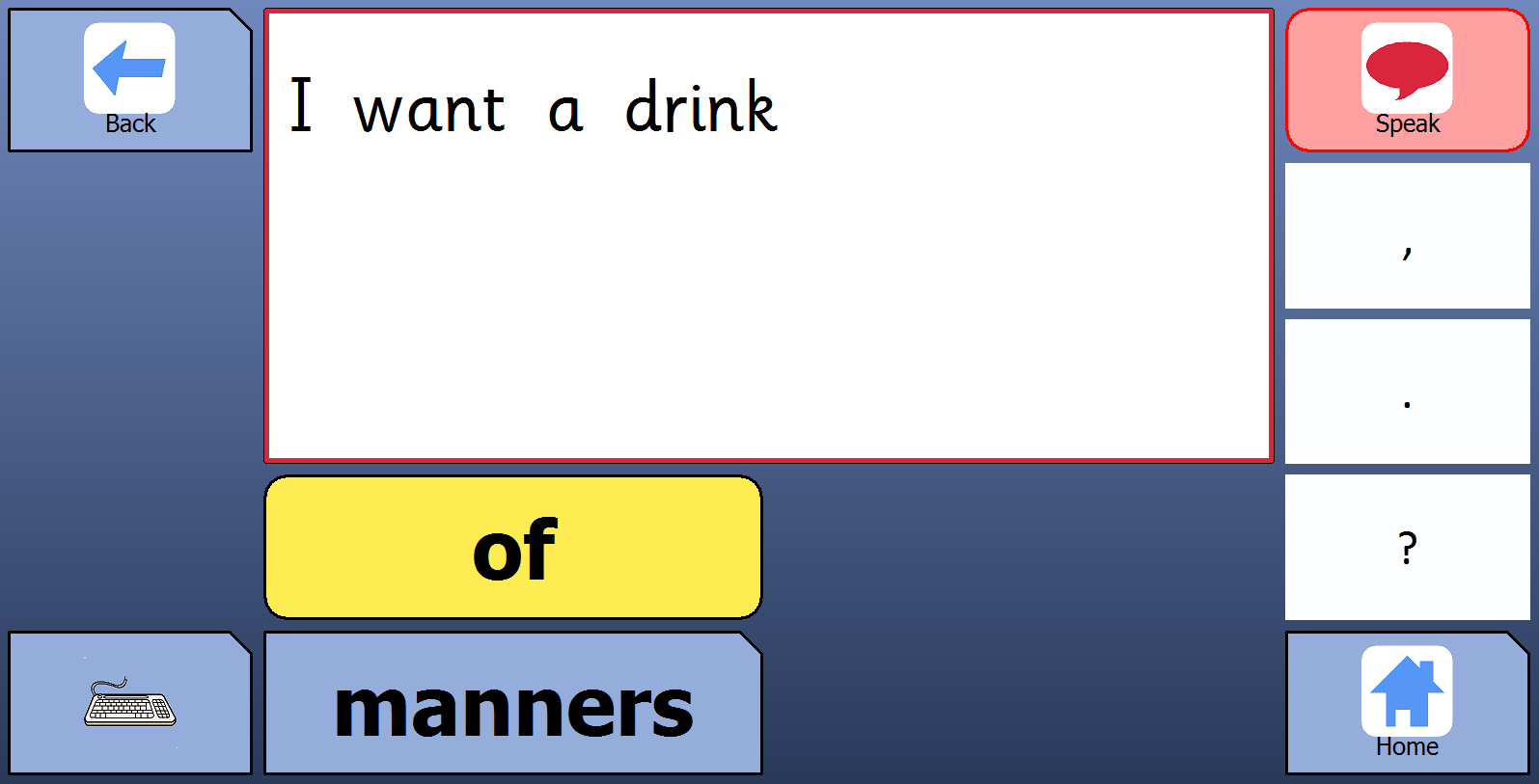
I want a drink

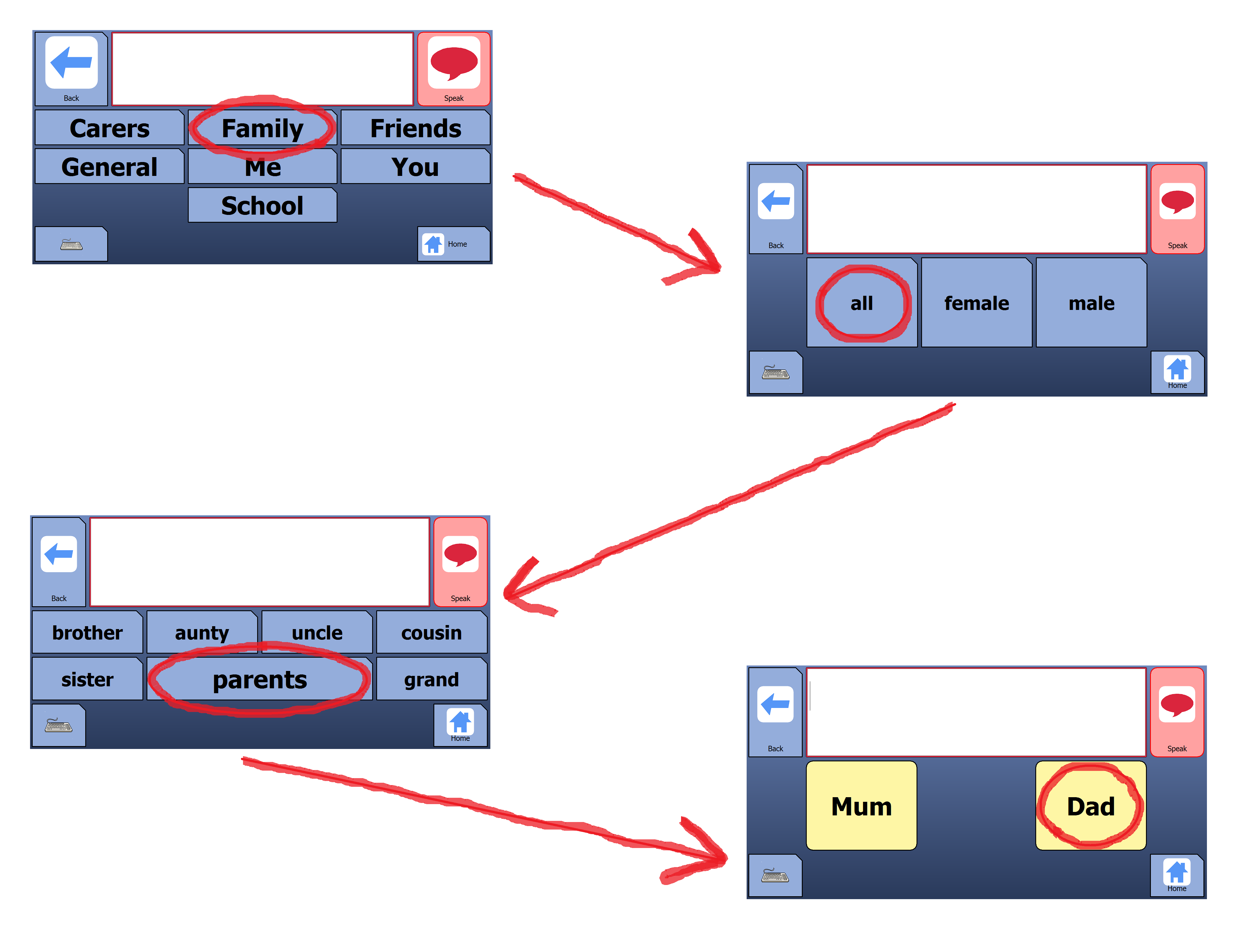
When the above sentence has been constructed the ‘manners’ group is offered so that the student can be polite in directing their request. As the student presses the ‘manners’ group it speaks “manners” so that the student hears this name; this then helps the student relate that information to the choices which they are about to make e.g. “please” or “thank you” and hearing that information over a period of time the student mentally categorizes it so that for example if they were to make a request without manners and the person receiving the request were to say to them “Manners” the student would then understand this prompt and either press the words “please” or “thank you” sequentially depending on which would be appropriate for either asking or receiving the request they had just made. After ‘Manners’ have been used the ‘People’ category is offered so that the student may personalize their request by using the names of the people they are directing their request too. Naturally there are a number of categories and subcategories in the ‘People’ category that additionally role model information so that the student becomes familiar with various groups of people and the type of relationship they have with those people from a personal or professional point of view.

people categories

These categories, their subcategories and groups not only role modeling this information by speaking it as they are selected but they also break down large lumps of data (that otherwise would create a visual overload of choices for the student) into smaller more manageable amounts of information that is far more digestible and easier for the student to work with. Over a period of time these role modeling categories raise the students awareness about the people in their lives which teaches them the understanding that those people all belong to a specific set of categories, subcategories and groups for example:

Categories/Subcategories/Groups/Group and Choice/Choices

People/Family/Parents/Dad or Mum

People/Family/Sister/Mia

People/School/Peers/Bobby, Daniel, Jack, Marshall and Oliver

People/School/Staff/Mr/Dheer

People/School/Staff/Mrs/Chambers, Clay or Pheasant

People/Carers/APTCOO/Paula, Tracey or Tash

People/Carers/Sue’s Family/Ellie, John or Sue

While on first look this may just seem like a reasonable way to present this type of information after a deeper examination over a period of time it has proven its worth by raising awareness in the students long term understanding which increases every time the student chooses a persons name for example like choosing ‘Dad’ because they are also hearing and seeing the other information which they are first required to navigate through ‘People’, ‘Family’ and ‘Parents’ which in turn role models the understanding in that whenever the student hears the word “Parents” spoken by other people they are then able to remember the information relevant to the categorized groups and choices they have followed (which leads them to ‘Dad’ and ‘Mum’) so the student then becomes aware (in Lia’s case) and understands that ‘Dad’ and ‘Mum’ are ‘grouped’ as ‘parents’ and that ‘Mia’ for example would be ‘grouped’ as her ‘sister’ and also that all of these three people are ‘categorized’ as ‘family’.

To put this detail into a basic perspective; the value of this information in the short term learning is about people, the categories, subcategories and groups of which they all belong in the relationship of connecting them to the requests and information that is being made or presented by the student. Whereas the long term learning is a role modeling experience that teaches the understanding of who people are and their relevance to the relationships within the lifestyle of the student.

© AORPETE LEARNING

Public Announcement

Welcome to My Autism Resources, this site is new and under construction – please feel free to read the ‘ABOUT’ section and check back at a later date when I have had the time to publish more information publicly.

Best Wishes to everyone and especially those people with autism, their families, friends, teachers and carers.

words home page

A snapshot from “Words” the communication application I developed for the Grid2.

© AORPETE LEARNING